Three destinations. Three investment strategies. One common philosophy: turning real estate into a professionally managed asset.
For many years, purchasing a property in the Mediterranean was primarily a lifestyle decision. Investors bought a holiday home, enjoyed it for a few weeks each year and accepted the costs associated with maintaining an asset that often remained empty.
Today, a different investment philosophy is gaining attention.
A new generation of hospitality-led real estate developments is combining private property ownership with professional hotel management, international hospitality brands and structured rental programmes.
The concept is relatively straightforward: instead of owning a holiday property that generates expenses when not in use, investors can acquire a residence that participates in a professionally managed accommodation business.
This creates an interesting proposition: the opportunity to combine real estate ownership, potential rental income, personal enjoyment and long-term capital appreciation.
However, not all developments operate in the same way. Some offer contractual rental returns, others distribute a percentage of hotel accommodation revenue, while certain branded residences are primarily positioned as luxury lifestyle and property investments.
We look at three developments in Spain that illustrate these different approaches.
The St. Regis Residences – Costa del Sol
The power of luxury branding and prime real estate

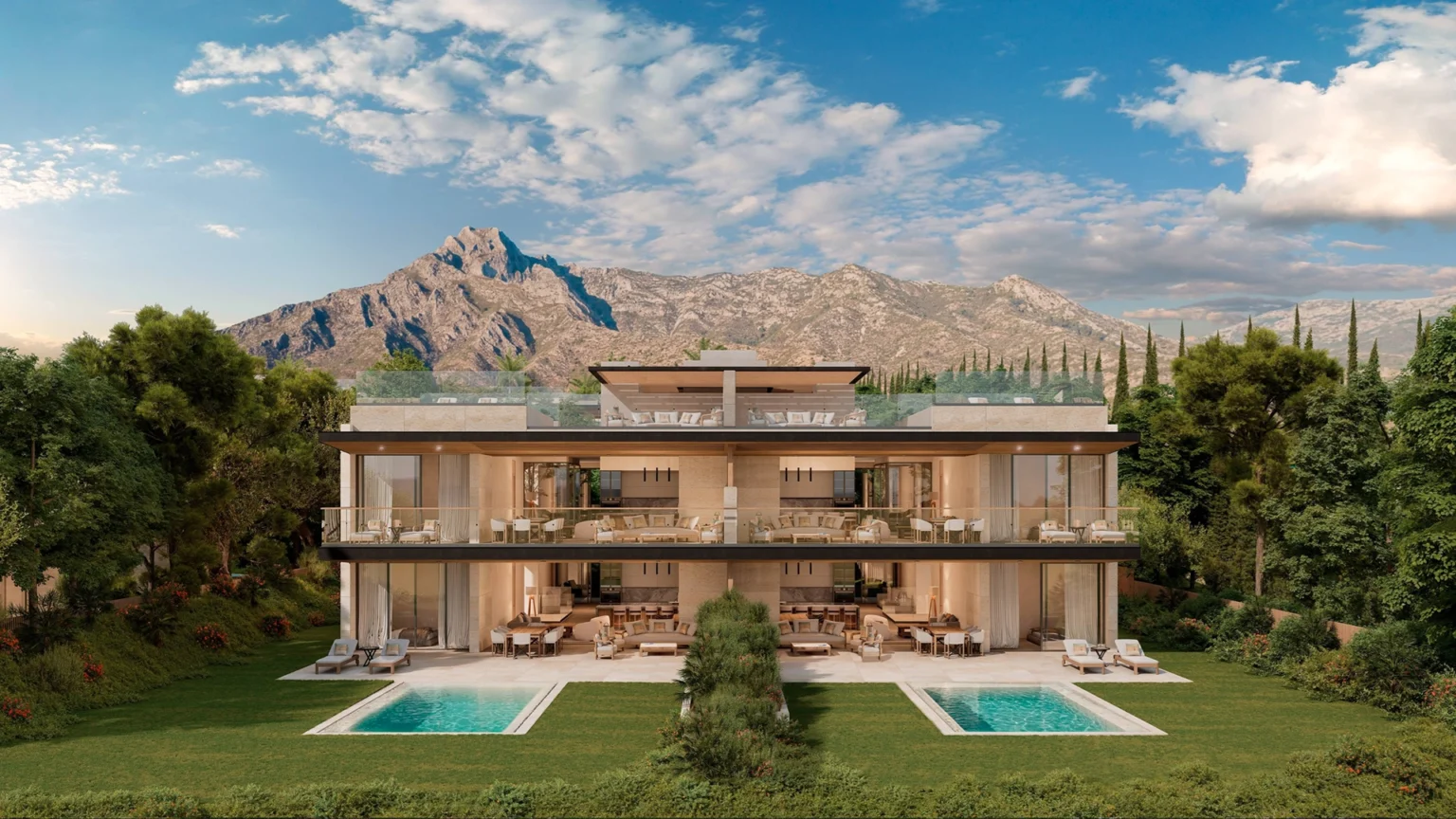
Located within the prestigious Finca Cortesin environment, between Marbella and Estepona, The St. Regis Residences Casares represents the ultra-luxury segment of this investment category.
The development comprises 46 exclusive residences, with two-, three- and four-bedroom configurations, including penthouses and duplex properties. Architecture is led by Marcio Kogan and Studio MK27, with interiors by Lázaro Rosa-Violán.
The project combines private residential ownership with the positioning, service philosophy and international recognition associated with the St. Regis hospitality brand.
The investment philosophy
Unlike conventional holiday apartments, the investment proposition here is primarily based on exclusivity, architectural quality, international brand recognition and the scarcity of prime luxury residential property.
For investors with a longer investment horizon, the appeal is not necessarily limited to annual rental income.
It is also about owning a distinctive asset in a destination that attracts international high-net-worth individuals.
The St. Regis name provides an additional positioning advantage, helping distinguish the residences within the competitive luxury property market.
Owners also benefit from the ONVIA by Marriott programme, which offers a range of lifestyle and hospitality-related benefits.
Why consider this investment?
- Limited supply: only 46 residences.
- Prime positioning within the Finca Cortesin environment.
- International luxury brand recognition.
- High-end architecture and design.
- Exposure to the long-term value of prime Mediterranean real estate.
The financial perspective
It is important to distinguish this opportunity from the two hotel-operated rental models discussed below.
The publicly available project information does not establish a standardised rental-income percentage or guaranteed annual return for St. Regis Casares.
An investor considering rental income should therefore obtain confirmation of the permitted rental arrangements, management structure, fees and expected operating costs directly from the developer.
For this asset, the investment analysis should focus on acquisition price, comparable luxury residential values, resale liquidity, ownership costs and any independently verified rental potential.
Investment profile: Luxury real estate, brand positioning and long-term capital appreciation potential.
Corales Residences – Tenerife
Luxury residential ownership combined with professional hotel management

Located in La Caleta, one of southern Tenerife’s most exclusive residential and hospitality destinations, Corales Residences introduces a different approach to investment property.
The development is part of the wider Corales Collection, an established luxury hospitality concept associated with the Royal Hideaway brand and Barceló Hotel Group.
The new residential development is scheduled for completion at the end of 2028 or the beginning of 2029.
The residences include three- and four-bedroom properties, penthouses and Royal Villas, with architecture designed by Leonardo Omar Arquitectos and K-Studio.
Prices are advertised from €2,200,000.
The investment philosophy
What makes Corales particularly interesting is its hotel-based rental distribution structure.
Owners acquire full property ownership, while the accommodation is integrated into a professional hospitality operation managed by Barceló Hotel Group.
When owners are not using their residences, the properties participate in the hotel’s rental operation.
Rather than managing bookings independently, owners benefit from the hotel’s marketing, distribution channels, operational infrastructure and international customer base.
How does the rental model work?
According to the published investment conditions, owners receive an amount equivalent to 21% of gross room revenue, based exclusively on accommodation income.
The programme operates through a rental pool, meaning revenue from comparable units is grouped and distributed proportionally.
Personal-use days are deducted from the calculation.
Importantly, the 21% is not a 21% return on the purchase price. It is a share of gross accommodation revenue, before the applicable owner expenses and deductions.
Illustrative income scenarios
To understand the potential financial implications, consider the following hypothetical scenarios:
| Annual gross room revenue attributable to the unit | Owner’s 21% share |
| 60,000 € | 12,600 € |
| 80,000 € | 16,800 € |
| 100,000 € | 21,000 € |
These figures are illustrative, not developer forecasts. Actual revenue will depend on hotel performance, room rates, occupancy, the rental-pool calculation and owner usage.
From the owner’s distribution, applicable costs must also be considered, including property tax, insurance, maintenance reserves, management fees and other contractual deductions.
Why consider this investment?
- Ownership of a luxury residential asset in La Caleta.
- Professional hotel management by Barceló Hotel Group.
- International hospitality distribution.
- A defined accommodation-revenue participation structure.
- Access to selected facilities and services within the wider Corales Collection.
- A combination of personal use and professionally managed rental operations.
Investment profile: Luxury hospitality investment with variable rental income linked to actual hotel performance.
Wyndham Portocolom – Mallorca
A more accessible entry point into professionally managed hospitality real estate
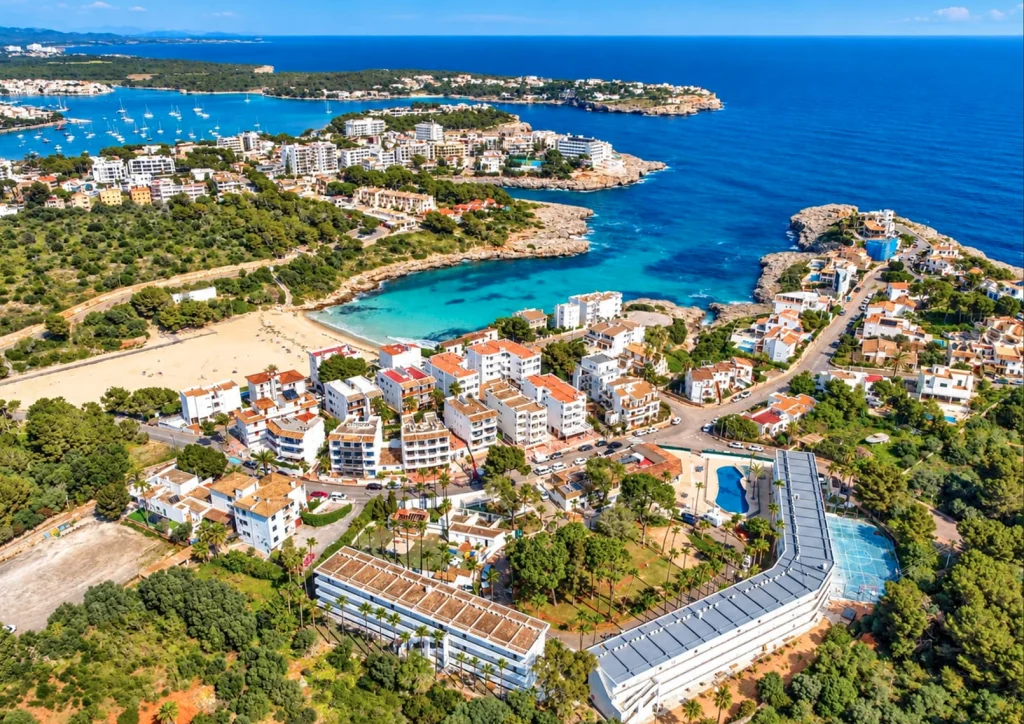
Located in Portocolom, on Mallorca’s east coast, Wyndham Portocolom represents a different segment of the branded hospitality investment market.
The resort offers refurbished, furnished apartments designed to operate within a professionally managed tourist accommodation environment.
Unlike the ultra-luxury positioning of St. Regis or Corales, Wyndham Portocolom offers a more accessible entry point, with advertised prices starting from €295,000.
The available configurations include studios, one-bedroom and two-bedroom apartments.
The investment philosophy
The concept is designed around simplicity and operational efficiency.
Investors acquire an individual property, which is furnished and prepared to hotel standards.
The apartment is incorporated into a professionally managed rental programme, with Wyndham handling marketing, reservations, housekeeping and maintenance.
This allows owners to participate in the holiday accommodation market without having to manage the day-to-day rental operation themselves.
How does the rental model work?
One of the most interesting features of Wyndham Portocolom is its advertised contractual rental programme.
The developer currently promotes:
5% net annual return for the first three years of the rental programme.
This is a contractual programme subject to its terms, participation requirements and owner-use restrictions. It should not be interpreted as a perpetual guarantee or a guarantee of the property’s capital value.
What could this mean financially?
Using the advertised starting price of €295,000 as an illustrative acquisition value:
| Metric | Amount |
| Purchase price | 295,000 € |
| Advertised annual net return | 5 % |
| Annual net income | 14,750 € |
| Three-year cumulative net income | 44,250 € |
This illustration assumes the full purchase price is eligible for the advertised programme, that all contractual conditions are met and that the owner does not incur additional costs outside those already included in the definition of net return.
Purchase taxes and acquisition costs are excluded.
The actual apartment price, eligible investment amount and contractual payment conditions must be checked before calculating the investor’s net yield.
Why consider this investment?
- Lower advertised entry price compared with the other two examples.
- Professionally managed rental operation.
- Furnished and equipped apartments.
- Advertised tourist accommodation licensing.
- International Wyndham hospitality brand.
- Contractual 5% net rental return for the first three years, subject to conditions.
- Individual property ownership and potential capital appreciation.
The resort also offers facilities including a swimming pool, gym, cinema room, coworking space, reception and housekeeping services.
Investment profile: Hospitality real estate with a defined initial contractual income structure and a more accessible acquisition price.
Investment models compared
Although the three projects share the concept of combining property ownership with hospitality, their investment structures are significantly different.
| Investment criteria | St. Regis | Corales | Wyndham |
| Location | Casares | Tenerife | Mallorca |
| Positioning | Ultra-luxury | Luxury hospitality | Resort hospitality |
| Management | Residence services; rental terms to verify | Barceló | Wyndham |
| Rental structure | Not publicly established | 21% of gross room revenue | Advertised 5% net for 3 years |
| Income certainty | Not established | Variable | Contractual, subject to conditions |
| Advertised starting price | Obtain current quotation | €2.2M | €295K |
| Main investment thesis | Prime luxury asset | Hotel-linked income | Contractual rental income |
The key distinction is that the three developments appeal to different investor profiles.
St. Regis is primarily a luxury real estate and lifestyle proposition.
Corales offers exposure to the operating performance of a luxury hotel through a structured revenue-sharing arrangement.
Wyndham offers a more clearly defined initial contractual rental return and a lower advertised entry price.
None of these investment structures should be assessed solely on the headline return. The acquisition price, operating costs, taxation, owner-use restrictions, financing and resale conditions all influence the final investment performance.
Why Spain remains an interesting market for hospitality real estate
The fundamentals of the Spanish tourism industry provide an important context for these investments.
According to the Spanish National Statistics Institute, Mallorca recorded approximately 49.5 million hotel overnight stays in 2025, Tenerife 26.2 million and the Costa del Sol 21.1 million.
These are three substantial tourism markets, each attracting a different combination of international visitors and accommodation demand.
For investors, this matters because professionally managed hospitality properties depend on more than the physical quality of the building.
Their performance is influenced by destination appeal, international connectivity, seasonality, average room rates, occupancy and the ability of the operator to attract guests throughout the year.
The luxury segment also benefits from a different customer profile, where accommodation quality, service, privacy and experience can be as important as location.
However, strong destination-level tourism statistics should never be confused with the projected performance of an individual property.
What should professional investors analyse before purchasing?
Before committing capital to a hospitality-led real estate investment, there are several questions worth addressing.
What exactly are you buying?
Confirm full ownership, title conditions, permitted property use, licensing and any restrictions on resale or rental.
How is rental income calculated?
Understand whether the return is based on gross room revenue, net operating income, a rental pool or a fixed contractual payment.
Which costs are included?
Request a complete breakdown of management fees, maintenance, insurance, property taxes, reserves, utilities and other charges.
What happens after the initial contractual period?
A three-year contractual return, for example, should be assessed separately from the long-term rental prospects of the property.
What are the personal-use restrictions?
The number of days an owner can occupy the property may directly affect rental income and investment flexibility.
What is the exit strategy?
Consider resale demand, future competition, transfer restrictions and the potential impact of changes in tourism regulations.
The most attractive investment is not necessarily the one with the highest advertised yield, but the one where the relationship between purchase price, operating performance, contractual protection and long-term asset value makes sense.
A new way of thinking about Mediterranean property ownership
The traditional concept of purchasing a holiday home is evolving.
For investors looking at the Spanish Mediterranean, hospitality-led residential developments provide an alternative way to approach real estate ownership.
They offer the possibility of combining a tangible property asset with professional management, international hospitality distribution and potential rental income.
The three projects presented here demonstrate how this concept can be adapted to different investment strategies, from ultra-luxury branded residences to structured hotel revenue-sharing and contractual rental programmes.
At Scout Mallorca, we believe that understanding the investment structure behind a property is just as important as understanding its location, architecture and lifestyle appeal.
Because ultimately, a successful real estate investment should be evaluated not only by how attractive the property looks, but also by how well the asset performs over time.
The question is no longer simply where to buy a second home. It is how to make that property work as an investment.
Investment disclaimer: This article is for general informational purposes only and does not constitute financial, legal or tax advice, nor an investment recommendation. All prices, returns and programme conditions should be independently verified with the relevant developer and reviewed against the applicable purchase and management agreements. Rental income and capital appreciation are not guaranteed unless expressly established by enforceable contractual provisions.